Piano Tuner’s Grave

A piano tuner tragically drowned here, alongside May Creek, when he misjudged the crossing during a flood in the early 20th Century.

Piano Tuner’s Grave

The story goes that during wet weather, the piano tuner had arrived at Anakie Railway Station from Rockhampton. Ignoring advice, he ventured off toward Sapphire. The man’s mode of transport has not been recorded; he may well have been walking. May Creek was in flood and the waters were rising.

→

Sadly, his body was located on March 15, 1906 and because the boggy ground made it impossible to carry the coffin (which had been made from wooden planks stored at Anakie Railway Station refreshment rooms) the decision was made to bury him at this spot. But it wasn’t easy.

→

The hole dug for the grave quickly filled with floodwater and the coffin floated! The burial party then drilled holes in the floor of the coffin. And so it was, that after much difficulty, the piano tuner was finally laid to rest.

↓

For many years since, historians had tried in vain to find out the identity of the piano tuner – even searches of the government archives failed to come up with the information. The plaque bearing the poem above eventually deteriorated, as did the grave and the wooden fence around it, and the identity of the piano tuner remained a mystery.

→

Then one day in 1992, Sapphire writer and researcher Terri Baker decided to make a few enquiries. She phoned the Emerald Court House to start her investigation. Other researchers had made the same approach over the years but were told that unless they had a date it was impossible to find a record of the death. 

→

However, Terri was lucky to speak to an enthusiastic young staff member, Murray Herwin, who was a tad more co-operative than his predecessors. He started his search from the first entry in the register in 1896 long before the 1920s, the time most historians thought the piano tuner had drowned.

↓

Friends, you have passed me by in this lonesome grave for this past half-hundred years, where I laughed my last laugh and wept my final tears.

TAMAM SHUD

From around the 1950s, a rustic plaque bearing an epitaph was all there was to identify this lonely resting place—The Piano Tuner’s Grave.

Mystery solved

Murray noted all the ‘death by drowning’ entries and, to everyone’s surprise, came up with the identity of the piano tuner. The mystery man was FW Schlieffen, aged 60, born in Germany, drowned in May Creek on March 13, 1906.

→

Inspired by this new information, Terri and a team of volunteers set about restoring the grave. It was in fact the fourth known upgrade, the others having been carried out in the 1930s, 1950s and 1983-84.

→

A temporary inscription, written in felt-pen, was placed on the headstone for the sake of a photograph for a newspaper article. Terri also approached the Emerald Shire Council to erect a permanent plaque. And waited….

↓

A revised story was printed in the July 2000 issue of the Gemfields Gazette and ended with the line: “The plaque is no longer legible, but that’s another job for someone else with the right enthusiasm.

→

This seemed to do the trick, and a couple of weeks later a council employee was sent from Emerald with the plaque Terri had requested. However, he arrived to find a handsome bronze plaque had already been placed on the front of the headstone. Also inspired by the newspaper article, this one had been donated and erected by the local funeral service.

→

Not to be defeated by this anomaly, the worker carried out his instructions and placed the plaque on the back of the headstone. So the piano tuner, whose anonymous grave stood for 94 years without a plaque, had now been adorned with two in the space of a fortnight. They say ‘good things come to those who wait’! 

↓

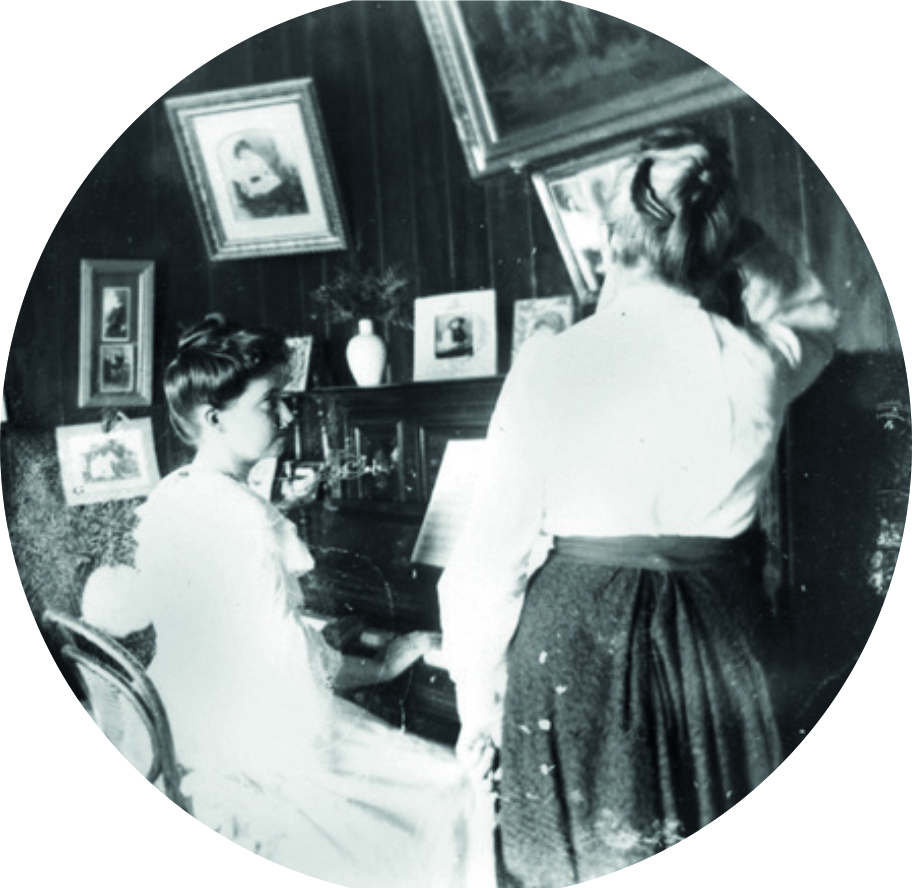
Humble piano in pioneering times

Music, song and dance were daily occurrences at all levels of society and for many outback pioneers, this also offered a link to the ‘old world’ and civilisation. Therefore, despite their remote location, some people were fortunate enough to have a piano as pride of place in their living room or parlour.

→

Early pianos were constructed with wooden frames. The local humidity and great temperature range would make the wood swell and contract, pulling and stretching the strings. This caused pianos to go out of tune, creating a regular need for a piano tuner.

↓

DID YOU KNOW?

> In an aural tuning (the only option available in outback Queensland in the early years) a tuning fork was used to tune the first note (generally A4) of the piano. Today, electronic tuning devices are available.
> The first piano to arrive in Australia was brought on the First Fleet HMS Sirius by George Worgan, a ship surgeon.
> Piano tuning became a profession around the beginning of the 1800s. Early piano tuners were trained and employed in piano factories, they often underwent an apprenticeship of about 5-7 years.

what3words

Download the what3words app to help you follow the Trail.
Here are the ///what3words identifiers for this location and for the three closest stops:

You are here: ///occupier.unexplored.stunned

Where to next?

Queensland Parliamentary Mace///section.lockdown.operation

Welcome to Sapphire///totals.treat.condoned

Miners’ Common – Sapphire///upbringing.restricting.songs

Scroll to Top